
Types of CNC Drill Bits: Uses, Benefits & How to Choose the Best
A drilled hole may meet its nominal diameter yet still fail inspection because of poor position accuracy, excessive burrs, or surface defects. The result depends on more than the cutting tool's diameter or material. Drill geometry, workpiece properties, hole depth, chip evacuation, and machine rigidity all influence the final outcome.
Understanding different CNC drill bit types helps manufacturers select tools that balance hole quality, process reliability, and production cost. This article examines common drilling tools, their applications, and the engineering factors that determine which option is suitable for a particular machining operation.
Types of CNC Drill Bits and Their Applications
The main types of drill bits used in CNC machining differ in their cutting geometry, construction, and intended applications. Some produce cylindrical holes, while others prepare starting features, create specialized profiles, or address demanding drilling conditions.
Twist Drill Bits
Twist drills are commonly used to produce cylindrical holes in metals and other machinable materials. Their helical flutes provide space for chips to move away from the cutting edges.
They are available in HSS, cobalt-alloyed HSS, and carbide, with geometries adapted to different materials. Their versatility makes them useful for general CNC drilling, although long holes, unstable setups, and difficult chip formation can limit performance.
Spot Drill Bits
Spot drills create shallow starting features that help establish the intended drilling location.
Their short, rigid construction can reduce the tendency of a following drill to move across the workpiece surface during entry. Spot drilling is useful in selected applications, but modern self-centering drills may not require a separate spotting operation.
Center Drill Bits
Center drills primarily produce center holes for supporting workpieces between centers during turning operations.
Although they are sometimes used to initiate holes, their geometry is designed for a different purpose from dedicated spot drills. Selecting one in place of the other requires consideration of the subsequent drilling operation.
Step Drill Bits
Step drills contain cutting sections of different diameters, allowing stepped features to be produced with one tool.
They are particularly useful for suitable thin materials and applications where multiple hole diameters are required. Their fixed step geometry limits flexibility when hole dimensions or material thicknesses differ from the tool design.
Flat-Bottom Drill Bits
Flat-bottom drills are designed to create holes or recesses with relatively flat bottom profiles.
They are useful when a conventional drill-point shape would leave an unsuitable conical bottom. Their performance depends on entry conditions, cutting geometry, and tool stability.
Solid-Carbide Drill Bits
Solid-carbide drills combine a rigid cutting body with wear-resistant cutting edges.
They are frequently selected for productive drilling in stable CNC machining setups. Their relatively high stiffness supports controlled cutting, but carbide is more susceptible to brittle cutting-edge damage under vibration or unstable engagement than tougher HSS tooling.
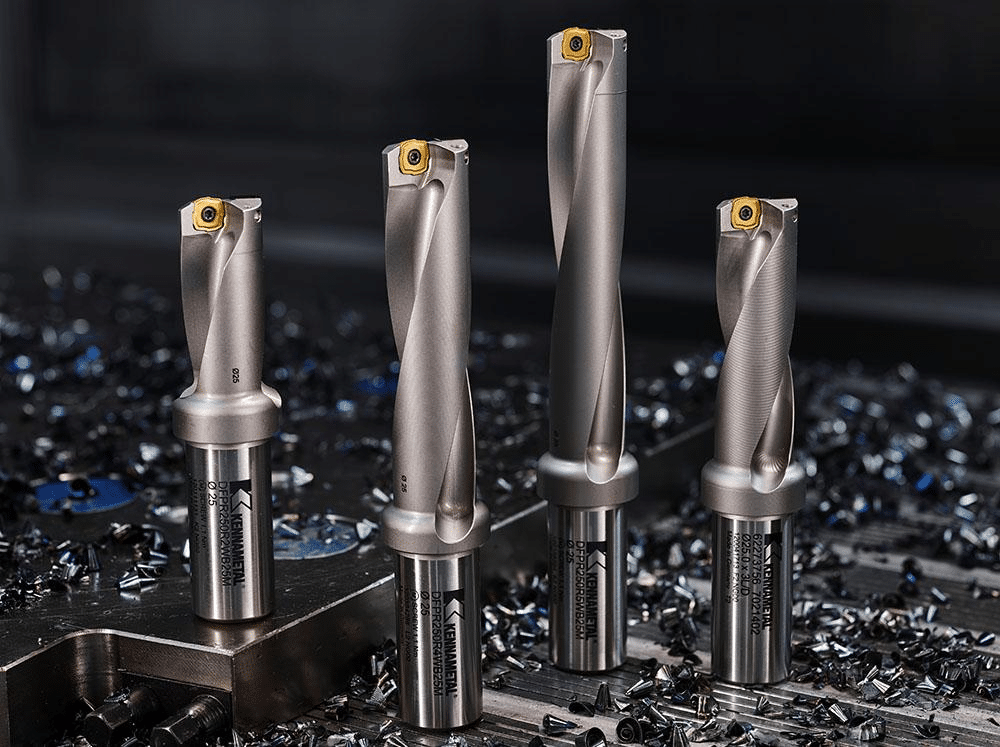
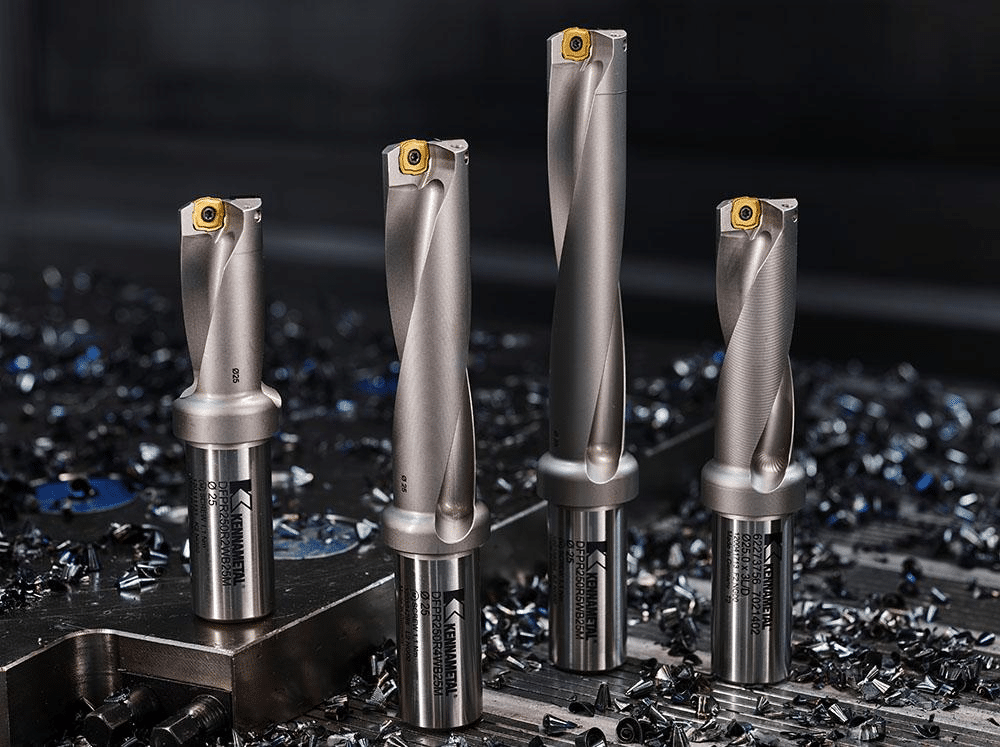
Indexable Insert Drill Bits
Indexable drills use replaceable cutting inserts mounted in a reusable tool body.
They are frequently considered for larger-diameter production holes where replacing cutting edges is more economical than replacing an entire solid tool. Insert geometry, drill-body condition, and setup stability influence performance and achievable hole quality.
Replaceable-Tip Drill Bits
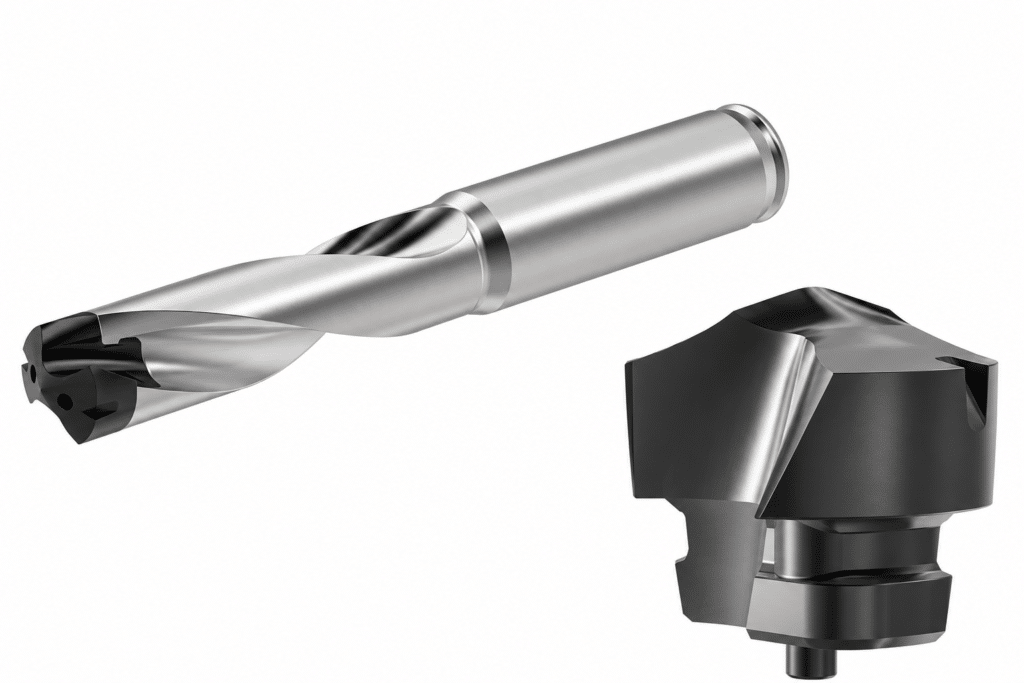
Replaceable-tip drills use a reusable body with a removable cutting head.
These modular systems can reduce the need to replace the entire tool after cutting-edge wear. They are particularly relevant to repeated production drilling, although diameter availability, tool-body compatibility, and cutting conditions determine their suitability.
Gun Drill Bits
Gun drills are specialized deep-hole drilling tools designed to guide the cutting action while supplying coolant and removing chips through a controlled flow path.
They are used where hole depth creates significant difficulties for conventional drilling. Gun drilling requires suitable equipment, guidance, and coolant delivery.
Micro Drill Bits
Microdrills produce small-diameter holes where cutting-edge strength, spindle runout, and chip evacuation are especially critical.
They are used in precision component manufacturing, including selected medical and electronic applications. Small increases in runout or cutting load can significantly affect tool reliability.
CNC Drill Bit Types Comparison
The following comparison summarizes common CNC drilling tools and the principal factors influencing their selection.
| Drill Type | Common Application | Key Benefit | Main Limitation |
|---|---|---|---|
| Twist drill | General cylindrical holes | Versatile holemaking | Depth and chip evacuation constraints |
| Spot drill | Hole initiation | Controlled starting location | Not intended for full-depth drilling |
| Center drill | Lathe center holes | Specialized center geometry | Not universally interchangeable with spot drills |
| Step drill | Multiple-diameter features | Combines selected operations | Fixed step dimensions |
| Flat-bottom drill | Flat-bottom features | Specialized bottom geometry | Entry and stability requirements |
| Solid-carbide drill | Productive precision drilling | Rigidity and wear resistance | Brittle failure risk under unstable conditions |
| Indexable drill | Suitable larger-diameter holes | Replaceable inserts | Application-dependent hole quality |
| Replaceable-tip drill | Repeated production drilling | Reusable tool body | System compatibility |
| Gun drill | Deep-hole machining | Specialized guidance and chip removal | Equipment and coolant requirements |
| Microdrill | Small precision holes | Small-hole capability | Runout and breakage sensitivity |
These categories are not entirely exclusive. For example, a twist drill may be manufactured from solid carbide, while other drilling systems are classified by their replaceable cutting-edge construction.
How Workpiece Material Affects Drill Bit Selection
Workpiece material influences drill geometry, cutting-tool substrate, coating selection, and coolant requirements. Hardness alone does not determine machinability; ductility, thermal behavior, and chip formation also affect drilling performance.
Drill Bits for Aluminum
Aluminum alloys can produce continuous chips and may develop built-up edges when material adheres to the cutting tool.
Sharp cutting edges, suitable flute geometry, and effective chip evacuation help control these problems. Uncoated or application-specific coated carbide drills may be appropriate, depending on the alloy and operating conditions.
Exit burrs also require attention. In a 2015 experimental study by Abdelhafeez and colleagues involving aerospace aluminum alloys, cutting parameters significantly affected burr formation and measured hole quality.
Drill Bits for Stainless Steel
Austenitic stainless steels can work-harden during machining. Excessive rubbing or unsuitable feeding may increase cutting resistance and accelerate tool wear.
Suitable drill geometry, stable feed conditions, and appropriate cooling are therefore important. Carbide tooling is often considered for productive operations, while HSS-based tools remain useful under appropriate conditions.
Recommendations must account for the particular stainless steel grade rather than treating all stainless steels identically.
Drill Bits for Titanium Alloys
Titanium drilling presents challenges involving concentrated cutting heat, cutting-edge wear, and burr formation.
A review published in Machining Science and Technology identifies high processing temperatures and tool deterioration as important limitations in conventional Ti-6Al-4V drilling.
Application-specific carbide tools, effective cooling, and controlled cutting conditions may help manage these difficulties. Tool selection should also consider hole depth and the final burr requirements.
Drill Bits for Carbon Steel and Cast Iron
Carbon and alloy steels require drill selection based on composition, hardness, heat treatment, and chip behavior.
Cast irons present different wear challenges because of their microstructure and potentially abrasive constituents. Suitable wear-resistant cutting edges can be beneficial, but drill geometry and cutting conditions should be matched to the specific material grade.
Hole Geometry, Drilling Depth, and Chip Evacuation
Hole geometry often determines whether a conventional twist drill is suitable or a specialized drilling system is necessary.
The depth-to-diameter ratio (L/D) is an important selection variable. As drilling depth increases, chip removal becomes more difficult and tool deflection can become more significant.
Hole Diameter and Drill Length
Longer drills generally have greater sensitivity to deflection and vibration than shorter tools of comparable construction.
Using the shortest practical drill improves the ability to maintain stable cutting conditions. Toolholding, workpiece support, and spindle runout must also be considered because they influence cutting-edge loading and hole alignment.
Drill Point Angle and Flute Geometry
Point geometry affects drilling entry, thrust forces, and cutting-edge engagement.
Flute geometry influences chip formation and available evacuation space. A geometry suitable for producing shorter chips in one alloy may be less effective in a ductile material that produces long, continuous chips.
No single point angle or flute design is optimal for every workpiece.
Deep-Hole Drilling Requirements
Deep-hole machining may require internally cooled drills, controlled entry procedures, or dedicated gun-drilling systems.
For example, Guhring specifies its RT 100 T Series 6511 solid-carbide drill for drilling depths up to 20×D. The manufacturer requires a defined pilot-hole procedure and controlled coolant operation.
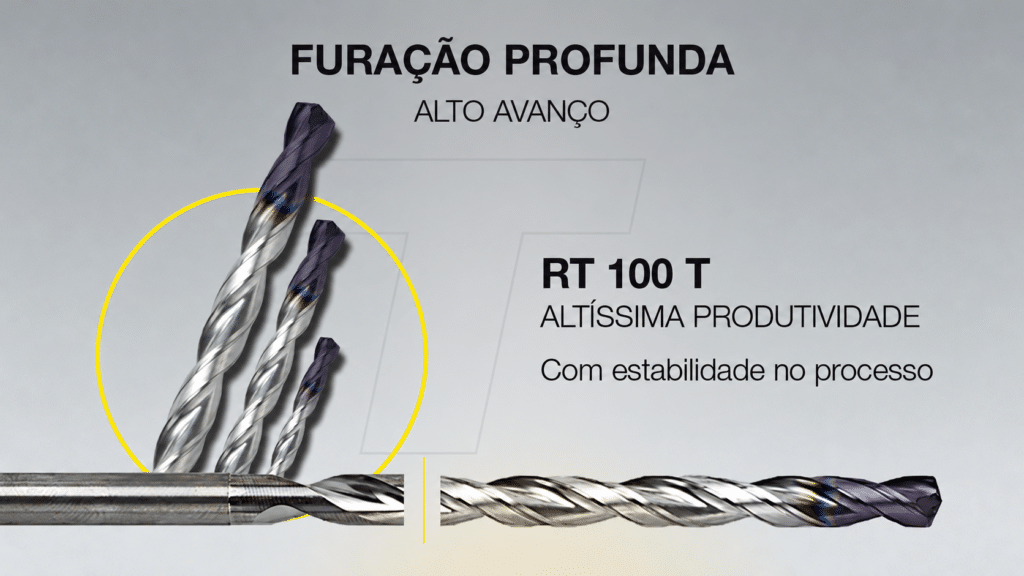
This is a product-specific capability, not a universal depth limit for conventional CNC drills.
Coolant Delivery and Chip Removal
Coolant can help manage cutting temperature and transport chips away from the cutting zone.
Through-tool coolant becomes especially valuable in drilling operations where external coolant cannot effectively reach the cutting edges.
Peck drilling may assist chip control in certain operations, but it should not be applied automatically. Some specialized deep-hole drills require continuous cutting after the prescribed entry procedure.
HSS vs. Carbide vs. Indexable vs. Replaceable-Tip Drills
Drill construction affects cutting performance, replacement economics, and machine requirements.
HSS drills offer relatively tough cutting edges and can be practical for lower-volume work or less rigid operating conditions. Cobalt-alloyed HSS provides improved hot-hardness characteristics for suitable applications.
Solid-carbide drills offer greater stiffness and wear resistance, supporting productive machining when the machine, workholding, and cutting parameters provide sufficient stability.
Indexable systems replace individual inserts instead of the complete tool body. Replaceable-tip systems similarly retain the body but replace the cutting head. Both constructions can offer economic advantages when their operating characteristics match production requirements.
Kennametal's technical guidance describes these differences in holemaking-tool construction and application selection.
The appropriate choice depends on hole diameter, material, machine capability, expected tool life, and production quantity. Higher cutting-tool purchase cost can be justified when improvements in machining time and process reliability reduce the overall cost per acceptable hole.
CNC Drilling Accuracy, Surface Finish, and Hole Quality
Producing a hole with the intended nominal diameter does not guarantee that it satisfies every drawing requirement.
Drill runout, cutting forces, tool wear, workpiece movement, and chip evacuation may affect hole diameter, roundness, location, and surface condition.
Hole Diameter and Positional Accuracy
A drilled hole must be evaluated against its specified dimensional and geometric requirements.
Tool deflection or misalignment may produce positional errors, while unequal cutting-edge engagement can influence hole size and circularity.
In the study by Abdelhafeez et al., out-of-roundness did not exceed 0.03 mm and hole-diameter deviation remained below 0.04 mm under the tested conditions. These are experimental findings, not universal drilling tolerances.
Burr Formation and Surface Quality
Burrs commonly occur when material plastically deforms near a hole's entry or exit.
Their formation depends on material behavior, cutting conditions, drill geometry, and tool condition.
The same 2015 study reported reductions in exit-burr height of up to 50% for the investigated titanium alloy and 75% for the investigated aluminum alloys under specific experimental conditions. Such results demonstrate the importance of parameter optimization rather than a guaranteed outcome for other applications.
Secondary Hole Finishing
Some holes require additional machining after drilling.
Reaming can improve selected dimensional and surface characteristics. Boring may be used where tighter control of an existing hole's geometry is required. Countersinking, counterboring, and deburring address other specified functional features.
The need for these operations depends on the engineering drawing.
Inspection and Quality Verification
Inspection should measure the characteristics required for component acceptance.
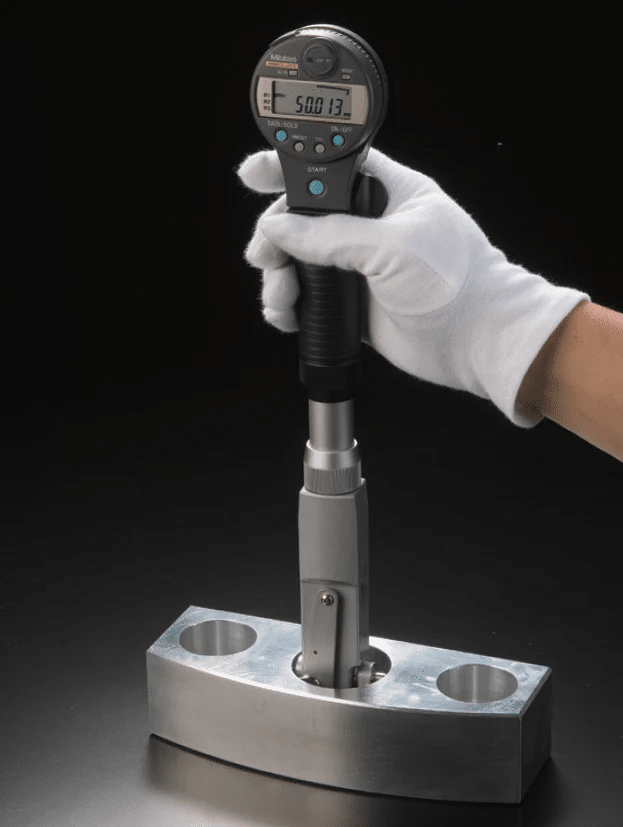
Bore gauges and appropriate dimensional instruments can check hole diameter. Coordinate measuring machines may verify hole position and geometric relationships, while surface-measurement equipment can assess specified roughness requirements.
A single diameter measurement cannot establish every aspect of hole quality.
How to Choose CNC Drill Bits for Your Application
Choosing the best drill bits for CNC machining requires a systematic assessment of the part and manufacturing setup.
- Identify the material. Confirm alloy grade, hardness, heat-treatment condition, and relevant chip-forming behavior.
- Define the hole. Review diameter, depth, blind or through-hole geometry, position, tolerance, and surface requirements.
- Select the drilling-tool family. Determine whether a general-purpose twist drill, specialized geometry, modular system, or deep-hole tool is appropriate.
- Evaluate the cutting-tool construction. Compare HSS, carbide, inserts, coatings, and cutting-edge geometries.
- Check machine capability. Confirm toolholding rigidity, available spindle performance, coolant delivery, and workholding stability.
- Review finishing requirements. Establish whether the drilling operation can satisfy final drawing requirements or whether secondary machining is needed.
- Validate production performance. Evaluate tool wear, cycle time, inspection results, and process consistency before committing to repeated production.
The correct selection should be supported by manufacturer application data and, where necessary, machining trials under representative production conditions.
CNC Drilling Cost and Production Considerations
The most economical drill is not necessarily the tool with the lowest purchase price. Total drilling cost depends on how reliably and efficiently the operation produces acceptable holes.
Cutting Tool and Replacement Costs
Solid drills may require replacement or reconditioning after wear. Indexable and modular systems allow selected cutting components to be replaced while retaining the tool body.
Whether this reduces cost depends on component pricing, tool life, and production quantity.
Machining Time and Tool Life
Higher cutting productivity may reduce spindle occupancy, but only when cutting conditions remain stable.
Premature wear, breakage, and tool changes can offset the expected productivity improvement.
Finishing, Inspection, and Rework
A faster drilling cycle may provide little benefit if the operation generates excessive burrs, dimensional errors, or additional finishing requirements.
The relevant economic measure is therefore the total cost per acceptable hole, including inspection and rework.
Prototype vs. High-Volume Production
Prototype machining often favors flexibility and readily available tooling.
Repeated production can justify application-specific drills, modular tooling, and optimized machining procedures when the resulting productivity and reliability support the investment.
Frequently Asked Questions
Can a CNC drill produce a precision hole without reaming?
Yes. Drilling alone may meet the required dimensions and surface specifications in suitable applications. Reaming or boring becomes necessary when the drilled hole cannot reliably satisfy the drawing's final requirements.
Is spot drilling always necessary before CNC drilling?
No. Some modern self-centering drills can start directly in suitable materials and machine setups. Spot drilling is useful when entry conditions, tool geometry, or positional requirements justify it.
How does drill runout affect hole quality?
Runout causes uneven cutting-edge engagement and can contribute to diameter variation, premature wear, vibration, and reduced hole accuracy. Proper toolholding and machine condition help control these effects.
When should a machinist use peck drilling instead of continuous drilling?
Peck drilling may be useful when chip accumulation becomes difficult to control. Continuous drilling may be preferable with suitable chip-breaking geometry and through-tool coolant. The tool manufacturer's recommended procedure should determine the final approach.
Conclusion
Selecting CNC drilling tools requires more than comparing tool materials or advertised cutting performance. The decision should begin with the workpiece material, hole geometry, dimensional requirements, and machining conditions.
Twist drills are versatile for conventional holes, while carbide, indexable, and replaceable-tip systems address different performance and production needs. Specialized deep-hole tools become relevant when guidance and chip evacuation impose additional constraints.
For custom components, the final drilling process should be evaluated alongside any required finishing and inspection. BaiChuan provides CNC milling, CNC turning, and custom metal machining services. Manufacturers can submit their engineering drawings, material specifications, hole requirements, and expected quantities for a manufacturability review and quotation.
References
Abdelhafeez, A. M., Soo, S. L., Aspinwall, D. K., Dowson, A., & Arnold, D. (2015). Burr Formation and Hole Quality when Drilling Titanium and Aluminium Alloys. Procedia CIRP, 37, 230–235.
https://doi.org/10.1016/j.procir.2015.08.019
Yuan, C. G., Pramanik, A., Basak, A. K., Prakash, C., & Shankar, S. (2021). Drilling of Titanium Alloy (Ti6Al4V) – A Review. Machining Science and Technology, 25(4), 637–702.
https://doi.org/10.1080/10910344.2021.1925295
Kennametal. How to Choose the Right Holemaking Tool. Manufacturer technical guidance.
Guhring. RT 100 T Deep Hole Drill, Series 6511 — 20×D Solid-Carbide Drill. Manufacturer technical specifications.
https://guhring.com/ProductsServices/SeriesDetails?Series=6511
Guhring. RT 100 T Deep Hole Drills — 20×D. Product catalog and technical drilling guidance.
https://guhring.com/media/catalogs/hbkbyevb0ee.pdf
BaiChuan . CNC Milling Services.
https://bccncmilling.com/service/cnc-machining/cnc-milling/
BaiChuan . CNC Turning Services.
https://bccncmilling.com/service/cnc-machining/cnc-turning/
Used In: Conclusion.