
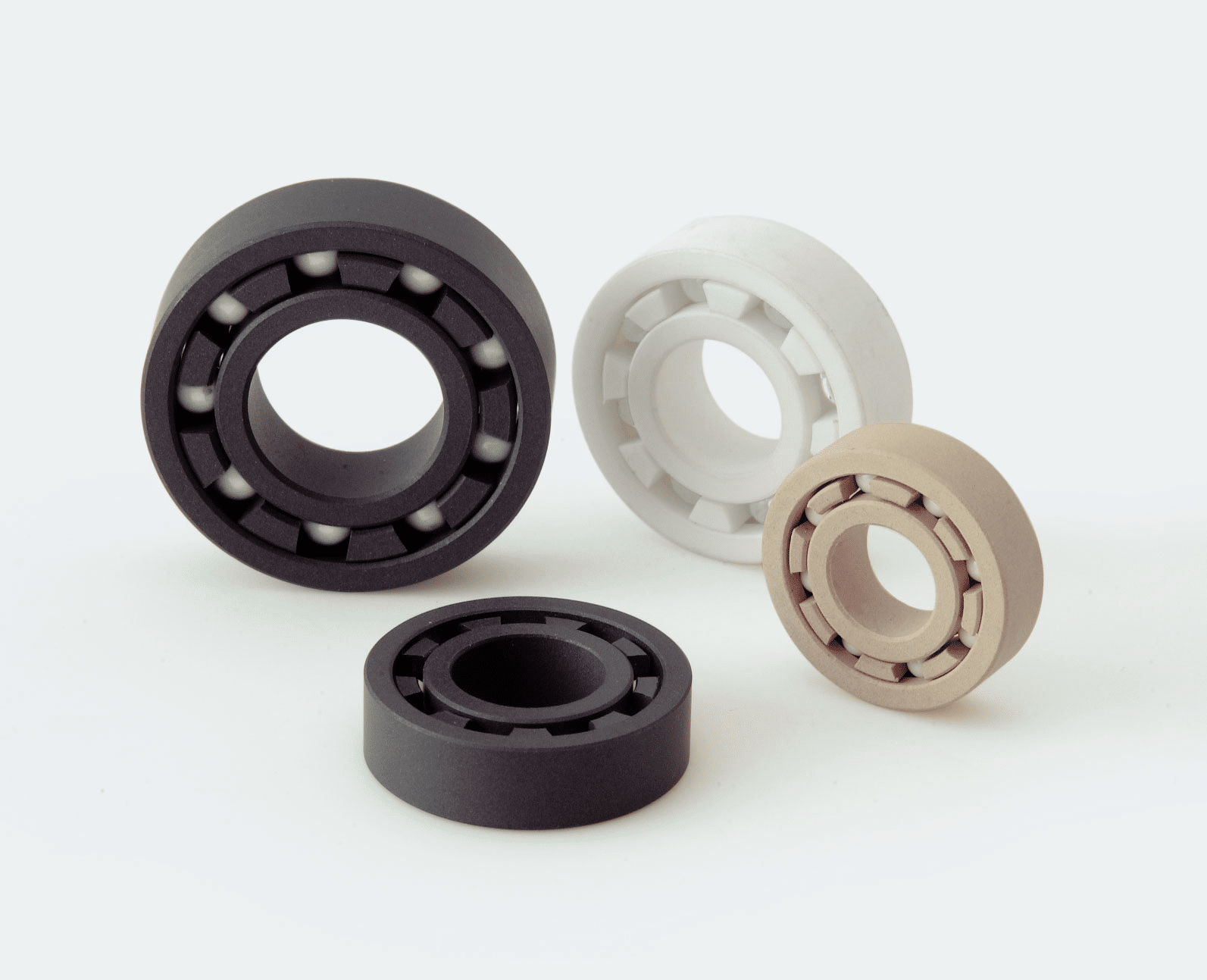
PEEK vs PTFE Bearings: Key Differences and Which Should You Choose?
PEEK and PTFE are both high-performance engineering plastics used in bearings, but they perform differently under load and friction. PEEK offers higher strength, stiffness, and wear resistance, while PTFE is known for its very low friction and strong self-lubricating properties.

Choosing between them depends on the conditions the bearing must handle. Load, operating temperature, friction, chemical exposure, wear, and dimensional stability all affect the choice. This guide compares PEEK and PTFE bearings across these factors and explains when each material is the better fit for a specific application.
What Is PEEK?
PEEK, or polyether ether ketone, is a high-performance semi-crystalline thermoplastic known for its combination of mechanical strength, heat resistance, chemical resistance, and wear performance. These properties make it suitable for demanding moving components such as bushings, seals, gears, and bearings, especially where metal replacement or dry operation is required. [1]

For bearing applications, the main properties of PEEK include:
- High strength and stiffness: PEEK can maintain its shape under higher mechanical loads than many other engineering plastics.
- Good wear resistance: It can perform well in sliding and rubbing applications, although its friction and wear behavior depends on the counterface and operating conditions.
- High temperature capability: PEEK retains useful mechanical properties at elevated temperatures, making it suitable for applications where ordinary plastics may deform or lose strength.
- Good chemical resistance: It can withstand many aggressive chemicals and industrial environments.
PEEK is also available in reinforced grades. Carbon fiber, glass fiber, graphite, and PTFE can be added to change its strength, friction, and wear behavior. This is important when selecting a bearing material because an unfilled PEEK bearing can behave quite differently from a filled PEEK composite. [2]
What Is PTFE?
PTFE, or polytetrafluoroethylene, is a fluoropolymer best known for its very low friction and strong resistance to chemical attack. It is widely used as a solid lubricant and in seals, sliding components, and bearings where low friction and self-lubrication are important. [3]

For bearing applications, PTFE is valued for:
- Very low friction: PTFE can provide smooth sliding with little or no external lubrication.
- Self-lubricating behavior: Its molecular structure allows relatively easy sliding between polymer chains, helping reduce friction.
- Excellent chemical resistance: PTFE remains stable in many chemicals and solvents.
- Good performance at elevated temperatures: It can be used in conditions where many conventional plastics would not be suitable.
However, pure PTFE has a major limitation for load-bearing applications. It has relatively low mechanical strength and can suffer from creep and high wear when subjected to sustained loads. For this reason, bearing-grade PTFE is often reinforced with materials such as glass fiber, carbon, or other fillers to improve its wear and load-carrying performance. [4]
Is PEEK Better Than PTFE? Key Differences
PEEK is usually the stronger choice when a bearing must handle higher loads, maintain its shape, and resist wear. PTFE is usually preferred when very low friction, self-lubrication, and chemical resistance are the main priorities. However, the actual result depends on the material grade, fillers, load, speed, temperature, and mating surface.
The following factors show where PEEK and PTFE differ most in bearing applications.
Strength and Load Capacity
PEEK has a clear advantage in mechanical strength and stiffness. It can carry higher loads while maintaining better dimensional stability, which is useful for bearings exposed to continuous mechanical stress. PTFE is much softer and more prone to deformation under sustained pressure. [5]
For example, a PEEK bearing may be more suitable for a heavily loaded shaft or industrial machine where the bearing must support a constant radial load. Pure PTFE is better suited to lighter loads, particularly when reducing friction is more important than structural strength.
| Property | PEEK | PTFE |
|---|---|---|
| Mechanical strength | High | Low |
| Stiffness | High | Low |
| Load capacity | Higher | Lower |
| Resistance to deformation | Better | More prone to creep |
Reinforced grades can change this comparison. Carbon fiber or glass fiber can increase the strength and stiffness of PEEK, while fillers can also improve the load and wear performance of PTFE. [6]
Friction and Self-Lubrication
PTFE has the advantage when very low friction is the main requirement. Its low surface energy and molecular structure allow surfaces to slide easily against it, which is why PTFE is widely used in dry-running bearings and other sliding components. [7]

PEEK can also operate without conventional lubrication, but unfilled PEEK generally has higher friction than PTFE. Its friction and wear behavior can improve significantly when it is modified with lubricating fillers such as PTFE or graphite.
This makes the choice more application-specific. A lightly loaded mechanism that needs smooth, low-friction movement may benefit from PTFE, while a bearing that needs both low friction and higher mechanical strength may use a filled PEEK grade.
Wear Resistance
PEEK generally offers better wear resistance than unfilled PTFE, particularly when the bearing is exposed to higher mechanical loads. PTFE can have very low friction but may wear quickly under severe sliding conditions because of its relatively low hardness and strength. [8]
However, PTFE should not be judged only in its pure form. Adding fillers such as glass fiber, carbon, or bronze can greatly improve its wear behavior. The same principle applies to PEEK, where different fillers are used to tailor the material for specific bearing conditions.
Temperature Range
Both materials can operate at elevated temperatures, but PEEK maintains its mechanical strength better as temperature increases. This matters when the bearing must carry a significant load while exposed to heat.
PTFE has a useful high-temperature operating range and retains its chemical stability in many demanding environments. However, its lower stiffness and greater tendency to creep can become more important as temperature and load increase.
For example, a bearing inside equipment exposed to continuous heat and mechanical load may favor reinforced PEEK. A low-load sliding component exposed to heat and aggressive chemicals may benefit from PTFE.
Chemical Resistance
PTFE has an advantage in chemical resistance. It is highly resistant to a wide range of chemicals and solvents, making it useful in chemical processing and other harsh environments. [9]

PEEK is also resistant to many chemicals and performs well in industrial environments. However, its resistance is not as broad as PTFE's for certain aggressive chemicals and conditions.
Therefore, chemical exposure alone does not automatically mean PTFE is the right choice. The chemical environment should be checked together with temperature, load, and mechanical requirements.
Cost and Machinability
PTFE is usually less expensive to process than PEEK, although the final bearing cost depends on the grade, filler content, manufacturing method, size, and required tolerances. PEEK is a higher-cost engineering thermoplastic, and machining it into precision bearing components can also increase the overall cost.
PEEK's higher cost can still make sense when its mechanical strength, dimensional stability, or wear resistance allows it to perform longer under demanding conditions. For less demanding applications, PTFE may provide the required performance at a lower material cost.
PEEK vs. PTFE Bearing Comparison
| Factor | PEEK | PTFE |
|---|---|---|
| Strength | Excellent | Low to moderate |
| Load capacity | High | Low to moderate |
| Friction | Low | Very low |
| Self-lubrication | Good | Excellent |
| Wear resistance | Very good, especially in reinforced grades | Moderate in pure form, improved with fillers |
| Temperature performance under load | Excellent | Good |
| Chemical resistance | Excellent | Exceptional |
| Creep resistance | Better | Lower |
| Dimensional stability | Better | Lower |
| Material cost | Higher | Lower to moderate |
| Typical advantage | Strength and durability | Low friction and chemical resistance |
The comparison shows why there is no single winner between PEEK and PTFE. PEEK becomes more attractive as mechanical load, wear, and dimensional stability become more important, while PTFE becomes more attractive when low friction and chemical resistance are the main concerns. [10]
What Are the Disadvantages of PEEK?
PEEK offers strong mechanical performance, but its higher performance comes with some trade-offs. The main disadvantages are its high cost, demanding machining requirements, and the fact that unfilled PEEK may not provide the lowest friction or best wear performance for every bearing application.

PEEK Engineered Plastic Bearings
Higher Material and Machining Cost
PEEK is significantly more expensive than common engineering plastics, including PTFE in many applications. Its high cost can become important when a bearing requires large quantities of material or frequent replacement.
Machining PEEK also requires careful control of cutting conditions because heat, residual stress, and poor machining practices can affect the final dimensions and surface quality. This can increase manufacturing costs for precision bearings. [11]
For example, using PEEK for a lightly loaded bearing where PTFE already provides adequate performance may not be cost-effective. PEEK's higher price is easier to justify when the application needs its strength, stiffness, or wear resistance.
Can Be Brittle Under Impact
PEEK is strong and stiff, but strength does not mean it is immune to impact damage. Under certain conditions, particularly with sharp stress concentrations or repeated impact loading, PEEK components can crack or fail.
The actual behavior depends on the grade and manufacturing process. Reinforced PEEK can provide higher stiffness and strength, but the added reinforcement can also change its toughness and failure behavior. [12]
For bearings exposed to sudden shock loads, engineers should therefore consider the complete loading pattern rather than selecting PEEK based only on its high strength.
Chemical Resistance Is Not Universal
PEEK has excellent resistance to many chemicals, but PTFE has broader chemical resistance in several aggressive environments. Certain strong acids, bases, solvents, or high-temperature chemical conditions can affect PEEK depending on exposure time and operating conditions. [13]
This distinction can matter in applications such as chemical processing. If the bearing is exposed to an aggressive chemical while carrying only a low mechanical load, PTFE may be more suitable.
Unfilled PEEK May Not Offer the Lowest Friction
PEEK can work as a dry-running bearing material, but unfilled PEEK does not match PTFE's extremely low friction in many sliding applications. Its tribological performance also changes with contact pressure, sliding speed, temperature, counterface material, and surface condition. [14]
This is why bearing manufacturers often use modified PEEK grades containing PTFE, graphite, carbon fiber, or other fillers. These formulations can reduce friction and wear while retaining much of PEEK's mechanical strength.
So, choosing PEEK does not necessarily mean using pure PEEK. The right grade can be just as important as choosing PEEK over PTFE in the first place.
What Are the Disadvantages of PTFE?
PTFE's biggest limitations are its lower mechanical strength, higher creep, and poor wear resistance in some unfilled forms. These issues become more important when a bearing must carry a high load or maintain tight dimensions for long periods.

Low Mechanical Strength and Load Capacity
Pure PTFE is soft compared with PEEK and many other engineering plastics. Under high contact pressure, it can deform more easily, which limits its use as a structural bearing material. [15]
This does not mean PTFE cannot be used for load-bearing applications. Filled PTFE compounds can have much better mechanical and tribological performance. However, the filler changes the material's properties, so a filled PTFE bearing should be evaluated as a specific compound rather than treated as ordinary PTFE.
Poor Wear Resistance Without Fillers
PTFE has very low friction, but low friction does not always mean low wear. Under high pressure and continuous sliding, unfilled PTFE can wear relatively quickly and form transfer films on the mating surface. [16]
Adding fillers such as glass fiber, carbon, graphite, or bronze can improve wear resistance and load capacity. For example, a filled PTFE bearing may be more suitable for continuous sliding than an unfilled PTFE bearing operating under the same load.
Creep and Cold Flow
PTFE has a strong tendency to creep when it remains under a constant load. The material can slowly deform over time, even when the applied stress is below its short-term strength.
This behavior can affect bearing clearance and dimensional accuracy, especially when a PTFE component is continuously compressed. Higher temperatures can make this problem more significant because polymer deformation tends to increase as temperature rises. [17]
For example, a PTFE bearing supporting a constant shaft load may gradually change shape. This can be a concern in precision equipment where the original bearing dimensions need to remain stable.
Lower Dimensional Stability
PTFE's low stiffness and tendency to creep make it less dimensionally stable than PEEK under sustained mechanical loads. This can limit its use in bearings that require tight tolerances or stable clearances over long operating periods.
PEEK is often better suited to these conditions because it combines higher stiffness with better resistance to deformation. However, PTFE can still be the practical choice when the bearing has a low mechanical load and the main requirement is extremely low friction.
When These Limitations Matter Most
PTFE's disadvantages become more important when the bearing must handle:
- High continuous loads: Greater pressure increases deformation and wear.
- Long periods under constant load: Creep can change the bearing's dimensions.
- Tight dimensional tolerances: Changes in shape can affect shaft clearance and alignment.
- High wear conditions: Unfilled PTFE may not provide sufficient service life.
- Structural support: PTFE's lower stiffness limits its ability to act as a rigid load-bearing component.
For demanding applications, engineers often use filled PTFE rather than pure PTFE. The right compound can improve strength and wear resistance while retaining much of PTFE's low-friction behavior.
Which Should You Choose?
Choose PEEK when the bearing needs higher load capacity, stiffness, wear resistance, or dimensional stability. Choose PTFE when very low friction, chemical resistance, and dry operation are more important than high mechanical strength.

The best choice also depends on the specific grade. Filled PEEK and filled PTFE can perform very differently from their unfilled forms, so the material specification should match the actual operating conditions.
Choose PEEK If You Need Higher Mechanical Performance
PEEK is usually a better fit when the bearing must support continuous mechanical loads while maintaining its shape. Its higher strength and stiffness can also help reduce deformation and maintain more stable clearances during operation.
PEEK can be considered for applications such as:
- High-load industrial machinery: Where the bearing is exposed to continuous radial or axial loads.
- High-temperature equipment: Where the material must retain mechanical performance as temperature increases.
- Precision components: Where dimensional stability and low deformation are important.
- High-wear applications: Where a longer service life is needed under demanding sliding conditions.
For example, a PEEK bearing can be useful in a high-load mechanical assembly where replacing a worn or deformed bearing would require significant downtime. Reinforced PEEK grades can provide additional strength and improved wear performance for these conditions. [1]
Choose PTFE If You Need Very Low Friction
PTFE is more suitable when minimizing friction is the main goal and the bearing does not need to carry very high mechanical loads. Its self-lubricating behavior can also reduce the need for external lubricants.
PTFE can be considered for:
- Low-load sliding systems: Where friction reduction is more important than high stiffness.
- Chemically aggressive environments: Where strong chemical resistance is required.
- Dry-running applications: Where adding conventional lubricant is difficult or undesirable.
- Applications requiring smooth movement: Such as certain valves, seals, and low-load sliding mechanisms.
PEEK vs. PTFE: Quick Decision Guide
| Application requirement | More suitable material | Why |
|---|---|---|
| High mechanical load | PEEK | Higher strength and stiffness |
| Very low friction | PTFE | Extremely low coefficient of friction |
| Long-term dimensional stability | PEEK | Better resistance to creep and deformation |
| Aggressive chemical exposure | PTFE | Broader chemical resistance |
| High wear conditions | PEEK | Better wear performance, especially in reinforced grades |
| Dry operation | PTFE | Strong self-lubricating behavior |
| High load at elevated temperature | PEEK | Better mechanical strength retention |
| Low-load precision sliding | PTFE | Low friction with little external lubrication |
| Need for improved strength and low friction | Filled PEEK | PEEK can be modified with lubricating fillers |
| Need for lower-cost low-friction material | PTFE | Often suitable when mechanical demands are moderate |
Consider a Hybrid Material
The choice does not always have to be pure PEEK or pure PTFE. PEEK can be modified with PTFE and other solid lubricants to reduce friction and improve wear behavior while retaining much of its mechanical strength.

Research on PEEK/PTFE composite systems has shown that adding PTFE can alter the friction and wear behavior of PEEK, making these formulations useful when an application needs a balance between mechanical performance and low-friction sliding. [1]
For this reason, engineers should compare the specific bearing compounds, not just the names PEEK and PTFE. Load, speed, temperature, mating surface, chemical exposure, lubrication, and required service life should all be considered before selecting the final material.
Conclusion
PEEK and PTFE bearings each have clear strengths, so there is no universal choice between them. PEEK is better suited to high loads, wear, heat, and dimensional stability, while PTFE is a strong option when very low friction, self-lubrication, and chemical resistance are the main requirements.
The final choice should consider the bearing's load, speed, temperature, environment, and expected service life. When neither material alone provides the right balance, a filled or reinforced grade, such as PTFE-filled PEEK, may offer a more suitable combination of properties.
References
Biswas, S. K., & Vijayan, K. (1992). Friction and wear of PTFE — A review. Wear, 158(1–2), 193–211. https://doi.org/10.1016/0043-1648(92)90039-b
Deshwal, D., Belgamwar, S. U., & Bekinal, S. I. (2025). Experimental analysis of PTFE and PTFE/PEEK composites for ball bearing applications. Scientific Reports, 16(1), 1461. PubMed. https://doi.org/10.1038/s41598-025-31212-w
Guru, S. R., Panda, S., Kumar, P., & Sarangi, M. (2024). A study on tribological performances of PEEK and PTFE based composites with MoS2 reinforcements. Polymer Composites, 45(8), 7329–7345. https://doi.org/10.1002/pc.28268
Hagino, H., Oyama, M., & Sasaki, S. (2015). Airborne brake wear particle emission due to braking and accelerating. Wear, 334–335, 44–48. https://doi.org/10.1016/j.wear.2015.04.012
Kolhe, S., Deshpande, A., & Wangikar, K. (2019). Wear behavior of polytetrafluoroethylene composites: A review. Lecture Notes on Multidisciplinary Industrial Engineering, 571–584. https://doi.org/10.1007/978-981-13-6148-7_55
Lin, Z., Zhang, K., Ye, J., Li, X., Zhao, X., Qu, T., Liu, Q., & Gao, B. (2022). The effects of filler type on the friction and wear performance of PEEK and PTFE composites under hybrid wear conditions. Wear, 490–491, 204178–204178. https://doi.org/10.1016/j.wear.2021.204178
Ling, X., Jing, X., Zhang, C., & Chen, S. (2020). Polyether ether ketone (PEEK) properties and its application status. IOP Conference Series: Earth and Environmental Science, 453(1), 012080. https://doi.org/10.1088/1755-1315/453/1/012080
Liu, Z., Xue, W., Bai, J., Shen, J., & Zhang, Z. (2026). Fatigue creep characteristics and performance prediction of PTFE gaskets undergone cryogenic liquid oxygen immersion aging. Thin-Walled Structures, 228, 115106. https://doi.org/10.1016/j.tws.2026.115106
Ma, Y., & Nutt, S. (2018). Chemical treatment for recycling of amine/epoxy composites at atmospheric pressure. Polymer Degradation and Stability, 153, 307–317. https://doi.org/10.1016/j.polymdegradstab.2018.05.011
Mao, K., Chetwynd, D. G., & Millson, M. (2020). A new method for testing polymer gear wear rate and performance. Polymer Testing, 82, 106323. https://doi.org/10.1016/j.polymertesting.2019.106323
Marzari, F., Tomasi, M., Zanoni, C., Dalla Ricca, E., & Bortoluzzi, D. (2026). Friction and wear of a low-speed PTFE/Ti-6Al-4V joint for a precise space mechanism. Advances in Space Research, 78(4), 3585–3597. https://doi.org/10.1016/j.asr.2026.06.037
Peeters, S., Klinghart, B., Schmidt, T., Reimers, M., Marius, B., Carberry, E., Leonhard, M., Georg, J., Gedan-Smolka, M., Florian, K., Moseler, M., Moras, G., & Reichenbach, T. (2027). Molecular mechanisms of peek/PTFE solid lubricants and application to rolling point contacts with PTFE-like friction and reduced lubricant consumption. Tribology International, 226, 112575. https://doi.org/10.1016/j.triboint.2026.112575
Puhan, D., & Wong, J. S. S. (2019). Properties of Polyetheretherketone (PEEK) transferred materials in a PEEK-steel contact. Tribology International, 135, 189–199. https://doi.org/10.1016/j.triboint.2019.02.028
Yeo, S. M., & Polycarpou, A. A. (2012). Tribological performance of PTFE- and PEEK-based coatings under oil-less compressor conditions. Wear, 296(1–2), 638–647. https://doi.org/10.1016/j.wear.2012.07.024
Zhang, J., de Souza, M., Creighton, C., & Varley, R. J. (2020). New approaches to bonding thermoplastic and thermoset polymer composites. Composites Part A: Applied Science and Manufacturing, 133, 105870. https://doi.org/10.1016/j.compositesa.2020.105870
Zhu, J., Ma, Le, & Dwyer-Joyce, R. (2019). Friction and wear behaviours of self-lubricating peek composites for articulating pin joints. Tribology International, 149, 105741–105741. https://doi.org/10.1016/j.triboint.2019.04.025
Zhu, Z., Yang, H., Wang, L., Mao, S., Jiang, T., Zhu, P., Wanyan, Q., & Duan, M. (2020). Systematic comparison study on determination of small organics/polymer miscibility. Polymer Testing, 91, 106828. https://doi.org/10.1016/j.polymertesting.2020.106828