
Ever received material that doesn't match your order? Material mix-ups can destroy expensive tooling, waste production time, and lead to rejected parts. Identifying metals correctly is critical, but not always straightforward.
You can identify TC4 titanium from stainless steel grades using simple workshop tests. Check magnetic response first—TC4 is non-magnetic, while some stainless steels attract magnets. Then compare weight, color, and hardness to further confirm material identity before cutting your first chip.
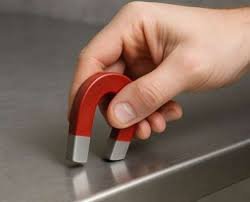
A magnet test is being performed on various metal samples
In my 15 years of CNC machining, I've seen countless material mix-ups that could have been prevented with basic identification techniques. While spectrometers provide definitive analysis, they're expensive and not always available in smaller shops. Let me show you the practical methods I use daily to verify materials before they reach our machines.
Why Is Quick Material Identification Critical in CNC Machining?
Have you ever ruined an expensive tool because you were machining the wrong material? Incorrect material identification leads to scrapped parts, damaged machines, and missed deadlines that damage your reputation.
Quick material identification saves you time and money by preventing machining with incorrect parameters. By confirming material types before production, you can select appropriate cutting tools, speeds, and feeds to optimize machining processes while avoiding catastrophic failures that could damage $10,000+ cutting tools or entire machine spindles.
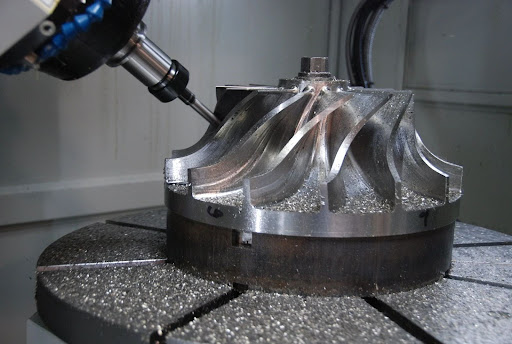
CNC machine processes correctly identified material
Material identification is crucial in modern manufacturing environments, especially when working with high-value alloys like TC4 titanium and specialized stainless steels. In our workshop, we've implemented a mandatory verification process because we've learned the hard way that trusting supplier labels isn't enough. One incident involved a mislabeled titanium bar that we mistakenly machined as stainless steel, resulting in a scrapped $5,000 part and a damaged $2,800 carbide end mill. Beyond the immediate financial impact, the wrong material can lead to component failure in critical applications—imagine an aerospace component failing due to incorrect material properties.
Material certificates help, but they can be separated from the material during handling. Many shops lack expensive spectrometers, making simple identification tests essential. Our standard procedure now involves checking magnetic response, appearance, weight, and machining characteristics before processing any high-value material. This approach has virtually eliminated costly material-related errors, improved our quality control, and strengthened customer confidence in our production processes. A systematic identification method also supports ISO certification requirements for material traceability and verification.
Can a Simple Magnet Test Distinguish Between Common Alloys?
Worried you might be working with the wrong metal? A quick test with a strong neodymium magnet can instantly provide valuable clues about your material's composition and save thousands in potential mistakes.
Magnetic response testing separates common engineering alloys into distinct categories. TC4 titanium and 300-series stainless steels (304, 316) are completely non-magnetic, while 2205 duplex stainless is weakly magnetic, and 17-4PH stainless steel shows strong magnetic attraction. This simple test can immediately narrow down your material identification.
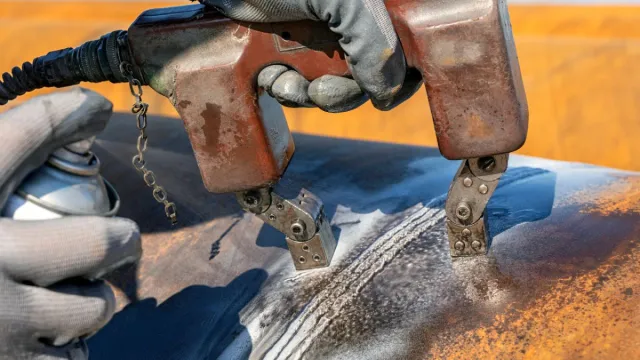
Testing the magnetic properties of various metal samples
The magnet test provides an excellent first-step screening tool that can be performed in seconds with minimal equipment. We use this method daily in our machine shop as part of our material verification protocol. The magnetic properties of these alloys stem from their different microstructures—austenitic stainless steels like 304 and 316 contain high nickel content creating a non-magnetic crystal structure, while ferritic and martensitic grades like portions of 17-4PH contain iron-chrome structures that retain magnetism.
Understanding these differences requires examining the material composition: TC4 titanium (Ti-6Al-4V) contains approximately 90% titanium, 6% aluminum, and 4% vanadium, creating a non-magnetic alloy. Standard 304 stainless contains approximately 18-20% chromium and 8-10.5% nickel in an austenitic structure that remains non-magnetic even after cold working. By comparison, 2205 duplex stainless has a mixed austenitic-ferritic microstructure that displays slight magnetic attraction, while 17-4PH contains significant martensitic content that creates strong magnetism.
The table below summarizes these magnetic responses:
| Material | Magnetic Response | Crystal Structure | Key Elements |
|---|---|---|---|
| TC4 Titanium | Non-magnetic | Alpha-Beta | Ti, Al, V |
| 304/316 SS | Non-magnetic | Austenitic | Cr, Ni, Mo (316) |
| 2205 Duplex SS | Weakly magnetic | Austenitic-Ferritic | Cr, Ni, Mo, N |
| 17-4PH SS | Strongly magnetic | Martensitic | Cr, Ni, Cu, Nb |
While this test isn't definitive alone, it provides excellent initial guidance before proceeding to other verification methods.
What Are the Key Visual and Physical Differences Between TC4, 304/316, 2205, and 17-4PH?
Can't tell which metal you're holding just by looking at it? The subtle color, finish, and weight differences between these alloys can actually reveal their identity to an experienced machinist's eye.
TC4 titanium appears darker gray with a bluish tint compared to stainless steel's brighter, more reflective finish. When comparing equal sizes, TC4 will be approximately 40% lighter than stainless varieties, making it noticeably lighter in hand. Surface finish also varies—titanium often has a duller, more matte appearance than the highly reflective stainless steels.
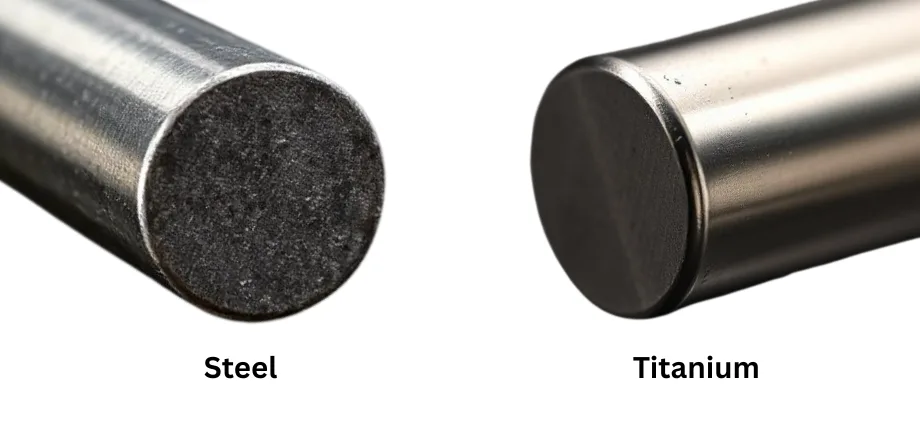
Side-by-side comparison of titanium and stainless steel samples
Visual and physical examination provides valuable identification clues beyond magnetic properties. In our daily operations, we've developed a systematic approach to distinguishing these materials. Color differences, while subtle, become apparent with experience—TC4 titanium has a characteristic grayish hue with slight blue or purple undertones, particularly noticeable when placed alongside stainless steels. The 304 and 316 grades exhibit a bright, silvery appearance, while 2205 duplex often appears slightly darker. The 17-4PH material typically shows a more matte silver finish compared to the austenitic varieties.
Weight comparison offers another reliable differentiation method. Due to its lower density (approximately 4.43 g/cm³ compared to stainless steel's 7.8-8.0 g/cm³), titanium feels remarkably lighter than a similarly sized piece of stainless steel. We often use a simple comparative weight test—holding samples of known materials in one hand and the unknown material in the other provides immediate tactile feedback about density differences.
Surface characteristics also provide identification clues. When freshly machined, TC4 titanium tends to display a distinctive cutting pattern and less reflectivity than stainless steel. Under strong light, you might notice subtle color variations in titanium that aren't present in stainless alloys. Additionally, titanium typically feels "warmer" to the touch than stainless steel due to its lower thermal conductivity.
The table below summarizes key visual and physical differences:
| Material | Color/Appearance | Relative Weight | Surface Characteristics |
|---|---|---|---|
| TC4 Titanium | Darker gray with bluish tint | Lightest (~40% lighter than SS) | Matte, warmer to touch |
| 304/316 SS | Bright silver | Heavy | Highly reflective |
| 2205 Duplex SS | Slightly darker silver | Heavy | Moderately reflective |
| 17-4PH SS | Matte silver | Heavy | Less reflective than 304/316 |
These visual and physical properties, combined with magnetic testing, significantly narrow down material identification possibilities.
How Can Weight and Hardness Help Verify Your Material Identification?
Uncertain if your identification is correct? Simple shop-floor hardness tests and basic weight calculations can confirm your material suspicions without expensive equipment.
Weight testing can distinguish titanium from stainless steel—with identical volumes, TC4 weighs about 4.43 g/cm³ while stainless steels average 7.8-8.0 g/cm³. For hardness, a file test reveals differences: 304/316 stainless are relatively soft (150-200 HB), while 17-4PH can reach 38-43 HRC when heat-treated, and TC4 typically measures around 330-350 HB.
Weight and hardness verification provide concrete data for material confirmation. In our workshop, we implemented a simple but effective weighing system using a precision digital scale. By measuring the exact dimensions of a sample piece and calculating its volume, we can determine its density with reasonable accuracy. This method has repeatedly helped us distinguish materials, particularly separating titanium from stainless steel variants.
For a practical example, we created reference samples of our commonly used materials—each precisely 1 cubic inch. The weight differences are unmistakable: our TC4 sample weighs approximately 0.16 pounds, while stainless steel samples weigh around 0.28-0.29 pounds. This 43% weight difference is immediately apparent, even when holding samples in hand.
Hardness testing adds another verification layer. While professional hardness testers provide precise measurements, several shop-floor methods offer useful approximations. The file test—where a standard high-quality file is drawn across the material—can indicate relative hardness. TC4 titanium and 17-4PH (particularly in heat-treated condition) will resist filing more than 304/316 stainless. For more precise measurements, portable hardness testers like Webster or Leeb testers provide numerical values without requiring laboratory equipment.
Machining characteristics also reveal material identity. When drilling or milling these materials, distinct differences emerge:
| Material | Chip Appearance | Cutting Resistance | Heat Generation |
|---|---|---|---|
| TC4 Titanium | Thin, segmented chips | High resistance | Low thermal conductivity, heat concentration |
| 304/316 SS | Long, stringy chips | Moderate resistance | High heat, work hardening |
| 2205 Duplex SS | Short, broken chips | High resistance | Moderate heat |
| 17-4PH SS | Controllable chips | High resistance | Lower work hardening than 304/316 |
These machining characteristics, combined with weight and hardness testing, provide comprehensive material verification when a spectrometer isn't available.
Conclusion
Proper material identification prevents costly errors in CNC machining. By combining magnetic testing, visual inspection, weight comparison, and hardness evaluation, you can reliably identify TC4 titanium from various stainless steel grades without specialized equipment.