
CNC milling is among the most versatile processes in modern manufacturing, capable of producing everything from simple flat surfaces to complex three-dimensional contours on a single machine. Behind every successful milling operation, however, is a cutting tool selected specifically for the job at hand. The choice of tool, its material, geometry, and coating directly determines part quality, machining efficiency, tool life, and ultimately the cost of producing the finished component.
Cutting Tools Used in CNC Machining
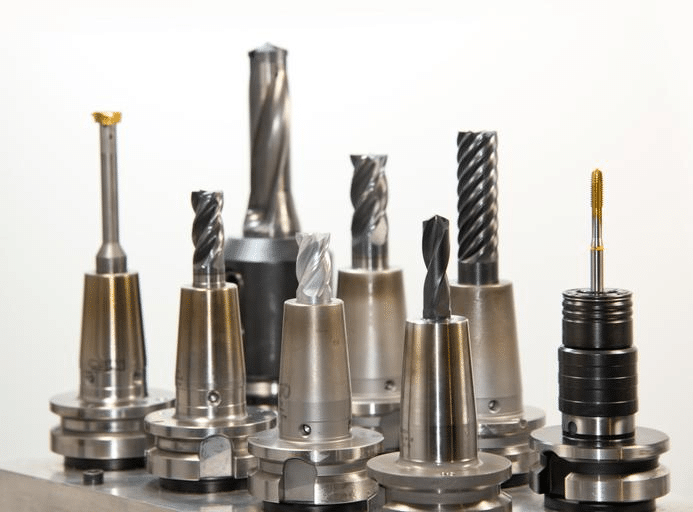
A well-equipped milling operation draws on a wide range of cutting tools, each designed for a specific task. End mills handle the majority of profiling, slotting, and contouring work, face mills tackle large flat surfaces efficiently, and a range of specialized tools address threading, chamfering, and keyway machining.
Understanding CNC Milling Cutting Tools
Before comparing specific tool types, it is useful to establish what milling cutting tools are, how they remove material, and what factors govern the selection process across different machining scenarios.
What are CNC Milling Cutting Tools?
CNC milling cutting tools are rotating tools with one or more cutting edges that remove material from a workpiece as the tool rotates and moves along a programmed path. Unlike turning, where the workpiece rotates against a stationary tool, milling reverses this relationship: the tool rotates at high speed while the workpiece, held stationary or moved along controlled axes, is brought into contact with the cutting edges. Material is removed in the form of chips as each cutting edge engages the workpiece in sequence during rotation [1].
Key Components of a Milling Tool
- Cutting edges: The sharpened surfaces that engage the workpiece and remove material. The number and geometry of cutting edges directly affect material removal rate and surface finish.
- Flutes: The helical or straight grooves between cutting edges that provide clearance for chip evacuation. Flute design influences chip flow, cutting forces, and surface finish quality.
- Shank: The cylindrical portion of the tool held in the machine's toolholder. Shank diameter and length affect tool rigidity and the maximum cutting depth achievable without excessive deflection.
- Tool coatings: Thin, hard surface layers applied to improve wear resistance, reduce friction, and extend tool life under demanding cutting conditions.
Factors Affecting Tool Selection
- Workpiece material: Different materials require different tool geometries, cutting edge counts, and coatings to achieve efficient material removal without excessive tool wear.
- Surface finish requirements: Fine finishing operations call for different tools, often with more cutting edges and specific geometries, than aggressive roughing operations.
- Part geometry: Internal corners, deep pockets, and complex contours each demand specific tool diameters and profiles to access and accurately reproduce the required features.
- Machine capabilities: Spindle speed range, available horsepower, and machine rigidity influence which tools can be run effectively and at what cutting parameters [2].
Machining an aluminum aerospace bracket and a hardened steel mold cavity illustrates how dramatically tool selection shifts with material. The aluminum part favors a high-helix, sharp-edged carbide end mill run at high spindle speed for fast, efficient chip evacuation and excellent surface finish. The hardened steel mold cavity, by contrast, requires a coated carbide or ceramic tool with a more robust edge geometry, run at significantly lower speeds and feeds to manage the cutting forces and heat generated when machining a much harder material.
End Mills: The Most Versatile CNC Milling Tools
End mills are the workhorse of CNC milling, capable of performing a wider range of operations than any other single tool category. Understanding the distinctions between end mill types is essential for selecting the right tool for a given feature or operation.

What Is an End Mill?
An end mill is a rotating cutting tool with cutting edges on both its end face and its peripheral surface, allowing it to cut in multiple directions simultaneously. This distinguishes end mills from drill bits, which are designed primarily for axial cutting to produce round holes and lack the peripheral cutting capability needed for slotting, profiling, or contouring operations. An end mill can plunge into material, cut along a profile, and machine pockets and contours, making it far more versatile than a drill for general milling work [3].
Common Types of End Mills
- Square end mills: Feature flat-bottomed cutting edges with sharp 90-degree corners, making them the standard choice for slotting, square-shouldered pockets, and general profiling where sharp internal corners are required.
- Ball nose end mills: Have a hemispherical cutting tip, allowing them to produce smooth, continuously curved surfaces. These are the standard tools for 3D contour machining, mold and die work, and any application requiring smoothly blended surfaces.
- Corner radius end mills: Combine the flat cutting profile of a square end mill with a small radius at the corner, increasing edge strength and reducing the stress concentration that leads to chipping. This geometry improves tool life significantly in roughing and semi-finishing applications.
- Roughing end mills: Feature a serrated or wavy cutting edge profile that breaks chips into smaller segments, reducing cutting forces and enabling higher material removal rates at the expense of surface finish, making them ideal for the initial stock removal stage before finishing operations [4].
Typical Applications
End mills support a broad range of milling operations:
- Slotting: Cutting straight channels into a workpiece, typically using square end mills sized to match the slot width.
- Profiling: Machining the outer or inner boundary of a part to a defined contour, following a programmed toolpath around the part perimeter.
- Pocket milling: Removing material from within a closed boundary to create a recessed cavity, commonly using a combination of roughing and finishing end mill passes.
- Contour machining: Producing complex, often non-planar surfaces using ball nose end mills following a three-dimensional toolpath derived from the part's CAD surface model.
Face Mills and Their Role in Surface Machining
While end mills handle the bulk of contouring and pocketing work, face mills serve a distinct purpose: producing large, flat surfaces efficiently and to a consistent finish. Understanding when to reach for a face mill rather than an end mill is an important part of efficient process planning.
What Is a Face Mill?
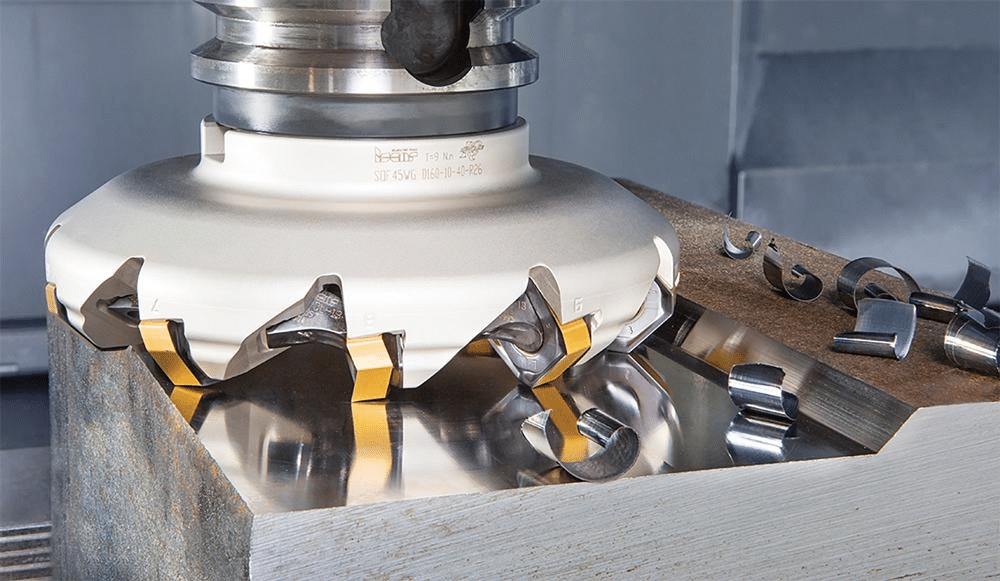
A face mill is a milling tool, typically larger in diameter than a standard end mill, designed with multiple replaceable cutting inserts arranged around its periphery. Rather than a single integral cutting edge, the face mill's multi-insert design allows each insert to engage the workpiece briefly during rotation, distributing cutting load across several edges and enabling much wider cutting widths in a single pass than a comparable end mill could achieve [5].
Advantages of Face Milling
- Faster material removal: The wide cutting width of a face mill, combined with multiple simultaneously engaged inserts, allows large flat areas to be machined in significantly less time than would be required using a smaller-diameter end mill, making multiple passes.
- Better surface finish on large flat areas: Face mills, particularly those fitted with wiper inserts, produce excellent flatness and surface finish across wide areas in a single pass, which is difficult to replicate with overlapping end mill passes.
- Improved productivity: The combination of faster material removal and superior surface finish reduces overall cycle time for parts with large flat features.
Common Applications
- Squaring stock material: Face milling is often the first operation performed on raw bar or plate stock, establishing a flat, accurate reference surface before further machining begins.
- Preparing reference surfaces: Datum surfaces used for subsequent fixturing or measurement are commonly face milled to ensure flatness and squareness relative to the rest of the part.
- Finishing large workpiece faces: Final finishing passes on large flat surfaces, such as machine bases or mounting plates, are typically performed with a face mill to achieve the required flatness and surface finish efficiently [6].
Face milling a steel block before precision machining begins is a standard first step in many machining sequences. The raw block, often slightly out of square and with an inconsistent surface from the sawing or rough stock preparation process, is face milled on its primary reference surfaces to establish accurate, flat datums. These datums then serve as the reliable reference points for all subsequent fixturing and machining operations performed on the part.
Other Important CNC Milling Cutting Tools
Beyond end mills and face mills, a range of specialized cutting tools addresses specific machining requirements that general-purpose tools cannot handle efficiently.
Shell Mills
Shell mills are large-diameter face milling tools designed to mount on a separate arbor rather than having an integral shank, making them economical for large-diameter facing and surfacing operations where a solid tool of equivalent diameter would be costly and heavy.
Fly Cutters
Fly cutters use a single cutting tool bit mounted in a rotating holder, producing a very fine surface finish at low cost. They are particularly useful for finishing large flat surfaces where surface quality matters more than material removal rate, and where the cost of a multi-insert face mill is not justified for the production volume involved.
T-Slot Cutters
T-slot cutters are specialized tools designed to machine the characteristic T-shaped slot used in machine tables, fixture plates, and tooling systems. The cutter typically requires a pre-machined straight slot, after which the T-slot cutter widens the base of the slot to create the undercut profile that allows T-nuts or bolts to slide and lock into position.
Chamfer Mills
Chamfer mills are angled cutting tools used to break sharp edges, remove burrs, and create consistent angled transitions on part edges. Chamfering improves part safety during handling, prepares edges for assembly, and can reduce stress concentration at sharp corners.
Thread Mills
Thread mills produce both internal and external threads through helical interpolation of a specially profiled cutting tool, offering an alternative to single-point threading or tapping. Thread milling is particularly valuable for large-diameter threads, hard materials, and applications where tap breakage in a high-value part would be unacceptable [7].
Keyseat and Woodruff Cutters
Keyseat cutters machine the straight slots used to seat keys that transmit torque between shafts and mounted components such as gears and pulleys. Woodruff cutters produce the curved-bottom keyway profile used with Woodruff keys, a common design in shaft applications requiring a self-aligning key seat.
Example
Using a thread mill to create threads in high-value aerospace components illustrates why this tool category exists alongside conventional tapping. In a titanium or high-strength steel aerospace fitting, a broken tap inside an expensive, nearly finished part can mean scrapping the entire component. Thread milling avoids this risk entirely, since the helical interpolation path of a thread mill does not subject the tool to the same risk of breakage as a tap advancing axially into a blind hole, while still producing accurate, repeatable thread geometry.
Cutting Tool Materials and Coatings
The base material of a cutting tool, combined with any applied coating, determines how the tool performs under specific cutting conditions, how long it lasts, and what materials it can machine effectively.
High-Speed Steel (HSS)
High-speed steel tools offer good toughness and are relatively inexpensive, making them suitable for general-purpose machining, particularly in lower-volume or job-shop environments. Their primary limitation is reduced heat resistance compared to carbide, restricting the cutting speeds at which they can be run without rapid wear or edge failure [8].
Solid Carbide Tools
Carbide tools offer significantly greater hardness and heat resistance than HSS, supporting much higher cutting speeds and longer tool life, particularly in production environments where cycle time efficiency matters. The tradeoff is greater brittleness compared to HSS, making carbide tools more susceptible to chipping under interrupted cuts or insufficient rigidity.
Ceramic and CBN Tools
Ceramic and cubic boron nitride (CBN) tools are reserved for high-temperature, high-speed machining of hardened steels and superalloys, where their exceptional hot hardness allows cutting speeds far beyond what carbide can sustain. These materials are brittle and require stable, rigid setups, but deliver substantial productivity gains in the specific hard-material applications they are designed for.
Common Tool Coatings
- TiN (Titanium Nitride): A general-purpose coating offering improved hardness and reduced friction over uncoated tools, suitable for a wide range of general machining applications.
- TiAlN (Titanium Aluminum Nitride): Provides excellent heat resistance and is well-suited to dry or high-speed machining of steel and stainless steel.
- AlTiN (Aluminum Titanium Nitride): Offers even greater high-temperature performance than TiAlN, commonly applied to tools used in machining hardened and difficult materials.
- DLC (Diamond-Like Carbon): Provides very low friction, making it well-suited to machining non-ferrous and abrasive materials such as aluminum and composites, where built-up edge and chip adhesion are concerns [9].
How Coatings Improve Performance
- Reduced wear: Hard coatings resist abrasive wear at the cutting edge, extending the useful life of the tool.
- Better heat resistance: Coatings reduce heat transfer into the tool substrate, preserving cutting edge hardness at elevated temperatures generated during cutting.
- Longer tool life: The combined effect of wear and heat resistance allows coated tools to maintain cutting performance over significantly more parts than an equivalent uncoated tool.
Example
Using TiAlN-coated carbide end mills for machining hardened steel components demonstrates coating selection matched to application demands. The combination of carbide's base hardness and TiAlN's heat resistance allows the tool to maintain its cutting edge through the high temperatures generated when machining hardened tool steel, where an uncoated or TiN-coated tool would wear rapidly and require far more frequent replacement.
Best Practices for Selecting CNC Milling Cutting Tools
Selecting the right tool consistently requires considering material, geometry, and cutting parameters together, rather than treating tool choice as an isolated decision.
Match the Tool to the Material
- Aluminum: Favors high-helix, sharp-edged carbide tools run at high speed, prioritizing efficient chip evacuation and excellent surface finish.
- Steel: Requires tools with robust edge geometry and appropriate coatings, balancing wear resistance against the toughness needed to handle moderate cutting forces.
- Stainless steel: Demands sharp cutting edges and careful parameter control to manage work hardening and heat generation, often favoring coated carbide tools with positive geometry.
- Titanium: Requires tools designed for low cutting speeds and high feed rates, with coatings and geometries selected specifically to manage the heat concentration characteristic of titanium machining.
Consider Tool Geometry
- Number of flutes: Fewer flutes provide more chip clearance, suited to softer materials and aggressive material removal, while more flutes improve surface finish in harder materials where chip volume is lower.
- Helix angle: Higher helix angles improve shearing action and chip evacuation, particularly beneficial in aluminum and other softer materials.
- Tool diameter: Larger diameters improve rigidity and material removal rate, while smaller diameters are necessary for accessing tight internal features and fine detail.
Optimize Cutting Parameters
- Spindle speed: Must be matched to the tool material, coating, and workpiece material to achieve an appropriate surface cutting speed.
- Feed rate: Governs chip thickness and directly affects both cutting forces and surface finish; must be balanced against spindle speed and depth of cut.
- Depth of cut: Roughing operations favor larger depths of cut to maximize material removal, while finishing operations use shallow depths to achieve dimensional accuracy and surface quality.
Monitor Tool Wear
Recognizing the signs of tool wear, including increased cutting forces, degraded surface finish, dimensional drift, and audible changes in the cutting sound, allows tools to be replaced at the appropriate time, before they cause part quality issues or catastrophic tool failure.
Reduce Machining Costs
Effective tool life management, including appropriate parameter selection and timely replacement, combined with proper tool maintenance and storage, reduces overall tooling expenditure while maintaining consistent part quality across production runs [10].
Conclusion
Selecting the right CNC milling cutting tool is fundamental to achieving precision, efficiency, and cost-effective production. End mills handle the majority of profiling, slotting, and contouring operations with remarkable versatility, while face mills excel at producing flat, accurately finished surfaces across wide areas. Specialized tools such as thread mills, chamfer mills, and keyseat cutters fill the gaps that general-purpose tools cannot address efficiently.
Beyond tool geometry, the choice of base material and coating determines how a tool performs under specific cutting conditions and how long it lasts in production. Matching tool material, geometry, and cutting parameters to the workpiece material and part requirements is what ultimately separates an efficient, cost-effective machining process from one plagued by excessive tool wear, poor surface finish, and inconsistent part quality. Thoughtful tool selection, applied consistently across a production operation, pays dividends in every part that comes off the machine.
References
Bag, R., Panda, A., Sahoo, A. K., & Kumar, R. (2022). Sustainable High-Speed Hard Machining of AISI 4340 steel under dry environment. Arabian Journal for Science and Engineering, 48(3), 3073–3096. https://doi.org/10.1007/s13369-022-07094-9
Bermanschläger, S. C., Baumann, C., Brünner, J., Kolozsvari, S., Mayrhofer, P. H., & Bleicher, F. (2026). Performance of TiN, (Ti,Al)N, and (Ti,Al,Ta,Ce)N coated tools in dry machining of C45E steel. CIRP Journal of Manufacturing Science and Technology, 66, 31–40. https://doi.org/10.1016/j.cirpj.2026.01.013
Dhobale, N., Mulik, S., Jegadeeshwaran, R., & Patange, A. (2021). Supervision of Milling Tool Inserts using Conventional and Artificial Intelligence Approach: A Review. Sound&Vibration, 55(2), 87–116. https://doi.org/10.32604/sv.2021.014224
Fan, M., Bi, C., Liu, X., Ding, M., & Song, H. (2023). Research on the design and Cutting Performance of revolving Lemniscate Milling Cutter. Research Square. https://doi.org/10.21203/rs.3.rs-3578726/v1
Globisch, S., Friedrich, M., Heidemann, N., & Döpper, F. (2024). Tool concept for a solid carbide end mill for roughing and finishing of the tool steel Toolox 44. Journal of Manufacturing and Materials Processing, 8(4), 170. https://doi.org/10.3390/jmmp8040170
Khattab, A., Sztankovics, I., & Felhő, C. (2025). Preliminary experimental comparison of plunge milling and face milling: influences of cutting parameters on cutting force and surface roughness. Eng—Advances in Engineering, 6(6), 128. https://doi.org/10.3390/eng6060128
Laghari, R. A., & Mekid, S. (2023). Comprehensive approach toward IIoT based condition monitoring of machining processes. Measurement, 217, 113004. https://doi.org/10.1016/j.measurement.2023.113004
Pajaziti, A., Tafilaj, O., Gjelaj, A., & Berisha, B. (2025). Optimization of toolpath planning and CNC machine performance in Time-Efficient machining. Machines, 13(1), 65. https://doi.org/10.3390/machines13010065
Silva, F. J. G., Martinho, R. P., Magalhães, L. L., Fernandes, F., Sales-Contini, R. C. M., Durão, L. M., Casais, R. C. B., & Sousa, V. F. C. (2024). A comparative study of different milling strategies on productivity, tool wear, surface roughness, and vibration. Journal of Manufacturing and Materials Processing, 8(3), 115. https://doi.org/10.3390/jmmp8030115
Stankov, N., & Ivanov, A. (2025). Analytical and graphical profiling of Thread-Milling cutters for forming internal threads. Applied Sciences, 15(13), 7308. https://doi.org/10.3390/app15137308