
Custom CNC Cutting Tools
Here's a question I hear a lot from people who buy machined parts: "Why would anyone pay extra for a custom cutting tool when the catalog is full of them?"
It's a fair question. Most CNC jobs run perfectly well on standard tools. But sometimes a part comes along that a catalog tool just can't handle, or can only handle slowly.
That's when a custom tool might earn its place. In this guide, I'll walk you through when custom tools make sense, what they can improve, and when you're better off skipping them.
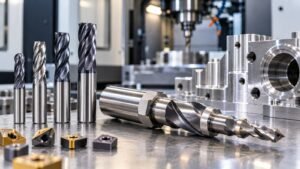
A combination tool, like the step drill in front, can cut several features in one pass.
First, What Is a Custom CNC Cutting Tool?
A standard (or "catalog") tool is one you can order from a supplier's catalog and often get from stock. Think regular drills, end mills and inserts.
A custom tool, often called a "special," is made to order for one specific job.
Specials don't have to be exotic, though. According to Canadian Metalworking, a special can be as simple as adding an advanced coating or changing the shank length of a standard design.
The Main Types You'll Come Across
- Modified standard tools: A catalog tool with a small change, such as a shorter length or a different corner radius.
- Form tools: Tools ground to match an exact shape, like an unusual groove or contour.
- Combination tools: One tool that cuts several features in a single pass, such as drilling, counterboring and chamfering a hole.
- Application-specific tools: Tools with a cutting-edge shape, flute count and coating chosen for one material or operation. (Flutes are the spiral grooves that carry chips away from the cut.)

When Do You Actually Need a Custom Tool?
In my view, a custom tool should solve a specific problem. If you can't name the problem, you probably don't need one.
Here are the five situations where I think a special deserves a serious look.
1. The Part Has a Shape Standard Tools Can't Make
A CNC machine can create many shapes by moving a standard cutter along a programmed path. But that approach has limits.
An internal groove with an odd profile, a non-standard thread or an undercut deep inside a bore might be impossible to reach with a catalog tool.
Cutting Tool Engineering names this as one of the clearest reasons to use a special: when standard tools simply can't produce the required geometry.
A form tool can cut that profile directly. Production Machining describes form tools as an efficient way to produce complex shapes rapidly.
2. You're Cutting a Tough Material
Some materials are hard on tools. Titanium is a good example.
Titanium alloys conduct heat poorly, only about one-seventh as well as steel, according to this titanium machining guide from Boze Metal. The heat can't escape through the chips, so it builds up at the cutting edge. Tool tip temperatures can reach around 1,000°C, which wears tools out fast.
BaiChuan's own titanium machining page notes the same issue: poor thermal conductivity and high chemical reactivity can easily lead to tool wear and workpiece deformation.
A tool designed for the material, with the right edge shape, coating and coolant path, may help it last longer. Still, I'd suggest testing premium catalog tools made for that material first. They may solve the problem without the wait.
3. Several Features Need to Line Up Perfectly
Picture a hole that needs a counterbore and a chamfer, all perfectly centered on each other. (A counterbore is a wider, flat-bottomed step at the top of a hole. A chamfer is a small angled edge.)
If you cut each feature with a separate tool, every tool change adds a chance for small errors to creep in.
A ground form or combination tool can hold the dimensional relationships between features, as Production Machining points out. All the cutting edges sit on one body, so they stay in the same position relative to each other.
There's a catch, though. You can't adjust each feature separately on a combination tool. If one section wears, you may need to regrind or replace the whole tool.
4. Your Machine Is Running Out of Room
Every CNC machine has a tool magazine, the rack that holds the tools it swaps in and out. On complex parts, those slots fill up quickly.
Production Machining notes that magazine positions may be limited on complex components, and that combination tools can help make up the difference.
Here's a striking example from Cutting Tool Engineering: a job shop might use five separate tools (spot drill, drill, reamer, spotface tool and chamfer tool) to finish one hole. A single custom combination tool can replace all five.
That frees four magazine slots and removes four tool changes from every part.
5. You're Making the Same Part Over and Over
Volume is the big one. A custom tool costs more up front, so you need enough parts to spread that cost across.
Canadian Metalworking puts it simply: for low-volume runs, a special tool doesn't necessarily make sense. But for high volumes or ongoing jobs, it may be the way to go.
Part value matters too. Canadian Metalworking also points to high-value parts, where scrapping even one piece is costly, as a good fit for specials.
In high-volume work, tiny savings add up. Cutting Tool Engineering notes that for manufacturers machining millions of parts a year, cutting just 1 second from the cycle time can lead to significant savings. (Cycle time is how long the machine takes to finish one part.)
What Can a Custom Tool Improve?
When the job is right, a well-designed special might improve several things at once.
Faster Cycle Times
Fewer tool changes and fewer passes mean less time per part. Production Machining says custom tools reduce cost per part mainly by cutting both cutting time and non-cutting time.
Higher Feed Rates
Feed rate is how fast the tool moves through the material. More flutes generally let a tool feed faster.
Cutting Tool Engineering explains that feed rates are directly proportional to the number of flutes. And according to Canadian Metalworking, standard tools generally have five or six flutes, while some applications call for 12 or more. That's a gap only a custom design can fill.
Longer Tool Life
Custom tools can include coolant ports that direct coolant right to the cutting zone, which may extend tool life, according to Production Machining.
Lower Tooling Cost (Sometimes)
This one surprises people. A special isn't always more expensive in the long run.
In one case reported by Cutting Tool Engineering, switching to a custom double-ended tool saved 35% on tooling cost. The new tool used a smaller shank and gave two cutting ends instead of one.
The same source describes a shop that only needed to mill flats 0.010 inches deep, yet used a tool with a 0.625-inch flute length. A shorter custom version did the same job and saved half an inch of carbide on every tool.
Sometimes the "special" is simply the right size.
Better Process Reliability
Fewer tools in the setup means fewer chances for an operator to load the wrong one. Production Machining lists this as another benefit of custom designs.
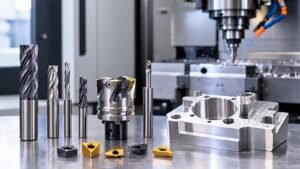
The right tool depends on the part's shape, its material and how many you need.
Standard vs. Custom Tools at a Glance
Neither option wins every time. Here's how they compare.
| Factor | Standard Tools | Custom Tools |
|---|---|---|
| Availability | Often in stock | Made to order, with a lead time |
| Upfront price | Lower and predictable | Higher, and can vary widely |
| Flexibility | Works across many jobs | Built for one part or operation |
| Shapes | Limited to catalog designs | Can match special profiles |
| Adjustment | Each tool adjusts separately | Combined features can't adjust separately |
| Replacement | Easy to find alternatives | Usually needs the original maker |
| Best for | Prototypes and short runs | Stable designs and high volumes |
My tip: don't compare tools by purchase price alone. Look at the total cost of making the part, including machine time, setups, scrap and spare tools.
A tool that costs three times more might still be the cheaper choice if it cuts your cycle time in half. On the other hand, a cheap catalog tool can be the smarter buy when you only need a few dozen parts.
The Downsides You Should Know About
I'd be doing you a disservice if I only listed the benefits. Specials come with real trade-offs.
You'll Wait for Them
A special isn't sitting on a shelf. Before anyone cuts metal, the tool maker usually prepares approval drawings, which can take anywhere from a day to a few weeks, according to Production Machining. Manufacturing comes after that.
Prices Are Less Predictable
Catalog prices tend to stay within a range. With specials, one supplier told Canadian Metalworking that the price can fluctuate dramatically.
They Only Do One Job
If the part is redesigned or discontinued, the tool may become useless. And if it breaks with no spare on hand, production could stop until a new one arrives.
My advice? If you go custom, plan for at least one spare.
A Simple Way to Check If It Pays Off
You don't need a complicated spreadsheet. Start with three numbers:
- Seconds saved per part
- Parts made per year
- Your machine's hourly cost (the full cost of running it for one hour, including labor and overhead)
Multiply seconds saved by yearly volume, then divide by 3,600 to get hours saved. Multiply that by the hourly cost, and you have your yearly savings.
A Quick Example
These figures are made up, just to show the math.
Say a combination tool saves 12 seconds per part, and your machine costs \$90 an hour to run.
- At 20,000 parts a year, you'd save about 67 machine hours, or roughly \$6,000.
- At 2,000 parts a year, you'd save only about 7 hours, or roughly \$600.
If the custom tool adds \$2,500 a year in tooling costs, it might pay off nicely at 20,000 parts. At 2,000 parts, it probably wouldn't.
See how much volume matters?
Before You Order a Special: My Checklist
If you're leaning toward a custom tool, these steps may help you avoid an expensive mistake.
- Record your current numbers: cycle time, tool life, scrap rate and yearly volume.
- Share everything with the tool maker: the part drawing, material, machine and toolholder details.
- Ask about alternatives. Could a modified standard tool or a small design change do the job?
- Plan for upkeep. Ask about regrinding, recoating and spare tools.
- Leave time for a trial run. Specials sometimes need fine-tuning after the first test.
That last point matters. Canadian Metalworking notes that specials may need optimization after the initial design.
Frequently Asked Questions
Are custom cutting tools always more expensive?
They usually cost more to buy. But the cost per part could end up lower if the tool saves enough machine time, setups or scrap.
Can custom tools be reground?
Many solid carbide tools can. Regrinding sharpens a worn tool so you can use it again. Agilix Solutions says reground tools often deliver about 80% of new-tool performance at a fraction of the cost. One thing to watch: an end mill's diameter changes slightly each time it's reground.
How long does it take to get a custom tool?
It depends on the design. Simple specials, like a standard tool with a new coating, are usually quicker. Complex form or combination tools take longer, since drawings need approval before production begins. Ask for a realistic lead time before you commit.
Is a modified standard tool a good middle ground?
It can be, especially when a catalog tool almost works. Keep in mind that regrinding a coated tool can strip its coating, which Canadian Metalworking warns may shorten tool life. Ask your supplier whether they'll recoat it.
When should I stick with standard tools?
For prototypes, one-off batches, rush orders and designs that are still changing. And honestly, if your standard tool already does the job well, there's no reason to switch.
My Take
Custom cutting tools aren't magic. They're a targeted fix for a specific problem.
If your part has a shape no catalog tool can cut, a material that eats through tools, or a production volume big enough to reward every saved second, a special might be well worth it.
If not, a good standard tool and smart programming will often serve you better.
Not sure which way to go? BaiChuan's CNC milling team can review your drawings and suggest a practical machining approach. For smaller batches, their short-run production service might be a good place to start.